Type one in below. You will get what its robots.txt says about each AI crawler today, the SHA-256 of the capture, and the date we first recorded it. Nothing to sign up for.
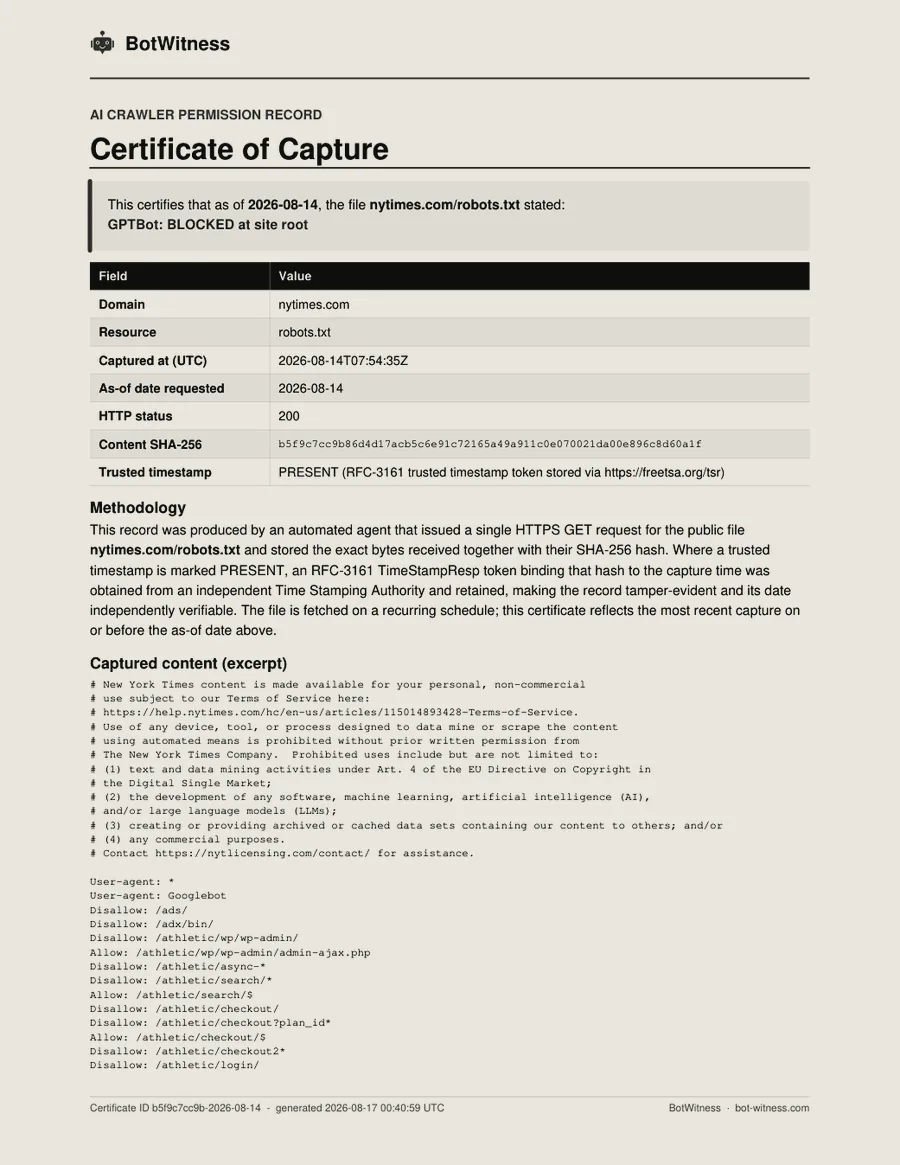
A dated exhibit stating what a named domain told a named AI crawler, with the capture time, the SHA-256 of the bytes served and an independent RFC-3161 timestamp printed on its face. Your expert, or the other side’s, can recompute the hash and validate the token without our cooperation. That is the point of it: the record was written on the day it happened, and it does not rest on our word.
Certificate of Capture
Crawler Compliance Audit
GPAI Disclosure Report
Monitoring · Starter
Litigation Evidence Package
Enterprise

The archive proves what a site said. These test what the models kept, and each method is labelled by what it can and cannot show. Verbatim reproduction and recognition of your exact wording are facts about how a model behaves. A membership statistic is a relative signal and we will not dress it up as a probability, because no honest one exists. When a model refuses to answer, the refusal goes in the report too.
The Opt-Out Efficacy Report is the one that needs both halves of the company: our timestamped record proves the date you blocked each crawler, then the probes test what models released after that date still reproduce of your text. Signal in a newer model does not on its own prove anybody crawled you afterwards, and the report says so on the page.
Read the specimen report, 49 KB PDF · How the opt-out report is put together
Opt-Out Efficacy Report
Training-Data Exposure Report
Benchmark Contamination Report
Exposure Monitoring
Defensive Exposure Audit
Every lookup, certificate, history and alert on this page is an endpoint before it is a document. If the question comes up often enough to be somebody’s job, it belongs inside your own systems rather than in a folder of downloaded PDFs. Current lookups and coverage cost nothing and need no key, so you can try the thing before you have an account.
« what nytimes.com tells GPTBot today. No key, no account »
curl "https://bot-witness.com/permission?domain=nytimes.com&agent=GPTBot"

« the signed exhibit for a past date, straight to disk »
curl "https://bot-witness.com/permission/certificate?domain=nytimes.com&agent=GPTBot&as_of=2026-08-14" \
  -H "Authorization: Bearer $KEY" -o certificate.pdf

« tell me when any of these change their mind about a crawler »
curl -X POST https://bot-witness.com/subscriptions -H "Authorization: Bearer $KEY" \
  -d '{"kind":"webhook","endpoint":"https://you.example/hook","domains":"nytimes.com,wsj.com"}'
For AI companies
Call /permission in the crawl path and take the answer from a record you do not control. Later, when a publisher asks what you were told, /attestation returns the whole crawl list over a date range as JSON or a filing-ready PDF.
For counsel
/history returns the timeline of a domain’s directives and /permission/certificate returns the signed PDF for any recorded date. Both take a domain and a date, so a docket tool can fetch the record when a matter opens instead of somebody remembering to.
For compliance teams
Subscribe domains to an email alert or an HMAC-signed webhook and a directive change arrives in your systems the day it happens. Feed your server log to /violations and every AI-crawler hit is judged against the robots.txt that was live at its timestamp. The log is never stored.
Read the API documentation: every endpoint with a worked request and the response it returns, the error codes, the rate limits, and what a plan changes.
| Stream | What we keep | Go |
|---|---|---|
| EU AI Act | What each general-purpose AI provider disclosed about its training content under Article 53(1)(d), revision by revision, including the days it published nothing at all. Enforcement started on 2 August 2026. | Disclosures |
| MCP | Daily sweeps of the registry and live tool manifests from remote servers. What a tool claimed to be on the day an agent trusted it. | Manifests |
| Web Bot Auth | Daily snapshots of the signing-key directories run by the major agent operators. Keys rotate, and yesterday disappears unless somebody kept it. | Keys |
| Hugging Face | Whether a model was public, under which licence, on which date. Deletions, gatings and licence edits become dated events. | Models |
| RSL | Really Simple Licensing terms declared in robots.txt across the tracked web, captured as served from the day a site first declares one. | Adoption |